



Renal Cell Carcinoma
Latest News
Advertisement
Video Series

Latest Videos







Shorts

0:30
Strategies for Sequencing Therapies in RCC
17 days ago
by
Daniel Heng, MD

0:30
Who Should Get Neoadjuvant Therapy in RCC
6 months ago
by
Naomi Haas, MD
0:44
Adjuvant Therapy in Non-Clear Cell RCC
6 months ago
by
Naomi Haas, MD

0:50
Don't Over-Treat Based on Risk Scores
6 months ago
by
Rami Komrokji, MD
0:42
Understanding MDS Staging and the Path to Cure
6 months ago
by
Rami Komrokji, MD

0:35
A Mass in the Right-Sided Kidney
7 months ago
by
Pavlos Msaouel, MD, PhD
0:33
The Key Test to Confirm RMC Diagnosis is Immunohistochemistry for INI1
7 months ago
by
Pavlos Msaouel, MD, PhD

0:34
The Future of Personalized Kidney Cancer Treatment
7 months ago
by
Karie Runcie, MD

0:35
Impressive Durability in New Cancer Combo Therapy
7 months ago
0:40
A Breakthrough in Renal Cell Carcinoma Treatment
7 months ago
by
Yousef Zakharia, MD
Podcasts





































Advertisement
More News

Clinicians weigh RCC immunotherapy choices by risk, metastasis site, and histology, citing durable outcomes with nivo-ipi and favoring TKIs after early progression.
FDA approves belzutifan plus lenvatinib for advanced clear cell RCC after PD-1/PD-L1 therapy, based on PFS and response rate benefit vs cabozantinib.
Oncologists weigh second-line options after IO/TKI failure in metastatic ccRCC, highlighting tolerability, mechanism shifts, and belzutifan’s broader role.

The FDA has approved Omcazio, a capsule-based formulation of cabozantinib as a laurylsulfate salt, that demonstrated bioequivalence to the existing tablet.

Adding radium-223 to cabozantinib did not improve skeletal event-free survival in the phase 2 RADICAL trial of renal cell carcinoma with bone metastases.
The FDA has granted breakthrough therapy and fast track designations to 68Ga-NYM096, a PET imaging agent for clear cell renal cell carcinoma.
The FDA has granted fast track designation to PLN-101095 plus pembrolizumab for ICI-refractory advanced or metastatic solid tumors.
Experts weigh TiNivo-2 and CONTACT-03, urging caution on PD-1 rechallenge in RCC and guiding tivozanib vs cabozantinib choices.
FDA Grants Tentative Approval to New Cabozantinib Capsule Formulation
Published: | Updated:
FDA tentatively OKs cabozantinib capsules for renal cell carcinoma, hepatocellular carcinoma, and epNETs, with dose-conversion guidance, error warning, and improved absorption.
Patients favor subcutaneous pembrolizumab for faster visits and comparable safety, signaling a convenient new option across solid tumors.
FIT-001 updates show darlifarnib plus cabozantinib drives 33% to 50% responses and 13‑month PFS in pretreated patients with cabozantinib-naive ccRCC.
Explore second-line options after ICI failure in metastatic ccRCC, featuring TiNivo-2 insights and tivozanib’s tolerability and PFS.
Phase 1 TRAVERSE results show that off-the-shelf CD70 CAR T ALLO-316 drives durable responses in refractory clear cell kidney cancer, with manageable safety signals.
Phase 2 KEYPAD shows pembrolizumab plus denosumab yields 31% responses and 7.5-month PFS in VEGFR-TKI–pretreated clear-cell RCC.
Long-term OMNIVORE follow-up shows that select advanced RCC responders stop nivolumab and remain treatment-free for years; salvage ipilimumab adds little.
FDA issues Complete Response Letter for manganese chloride tetrahydrate (Orviglance), an oral liver MRI contrast agent for renal-impaired patients.
Experts weigh leading IO/TKI combos for advanced RCC, comparing trials, toxicities, metastasis sites, and CNS strategy to personalize first-line care.
Experts debate tivozanib’s durable responses and tolerability after immunotherapy in metastatic RCC, shaping smarter VEGFR-TKI sequencing.
Myriad’s Precise MRD expands to breast, colorectal and renal cancers, using serial ctDNA tracking to spot residual disease and predict response.
The adjuvant approval of the belzutifan combination is supported by the LITESPARK-022 trial.
Experts debate first-line poor-risk metastatic ccRCC: ICI‑TKI for rapid control vs dual ICI for durable benefit, guided by updated NCCN 2026.
Oncologists weigh second-line options after ICI failure in metastatic ccRCC, spotlighting lenvatinib/everolimus, new agents, and ICI rechallenge.

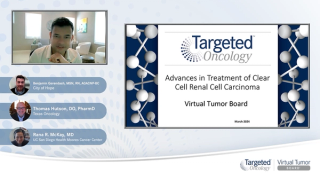
During a live event, Thomas Hutson, DO, PharmD, PhD, and participants discussed current best practice with adjuvant IO post-nephrectomy.
The phase 3 LITESPARK-012 trial failed to meet primary end points of PFS/OS for adding belzutifan or quavonlimab to the standard pembro/lenvatinib doublet.
Darlifarnib may enable the rechallenging of patients with cabozantinib in a combination context for patients with clear cell renal cell carcinoma.
Advertisement
Advertisement
Trending on Targeted Oncology - Immunotherapy, Biomarkers, and Cancer Pathways
1
Insurance Delays and Travel Strain CAR T Referral in Early Relapsed Myeloma
2
NCCN Guidelines Add Cosibelimab for Locally Advanced CSCC
3
Real-World Data for Darolutamide vs Abiraterone Triplet Therapy in mHSPC
4
Oncologists Debate Role of On-Body Injector for Transplant-Ineligible Myeloma
5